
Feature history • 007 legacy
James Bond Through History
From Ian Fleming’s postwar imagination to the longest-running spy-film dynasty in cinema, Bond has survived the Cold War, the blockbuster age, reinvention, parody, and the streaming-era question: what should 007 be next?

Bond first appeared in Fleming’s novel Casino Royale, first published in 1953.
Dr. No began the EON-produced film series with Sean Connery as 007.
Connery, Lazenby, Moore, Dalton, Brosnan, and Craig have led the main series.
No Time To Die closed Daniel Craig’s five-film run as Bond.
The origin story
Before the tuxedo: Fleming’s hard-edged secret agent
James Bond began on the page, not the screen. Ian Fleming, a former naval intelligence officer and journalist, introduced “agent 007” in Casino Royale. The official Ian Fleming site describes the book as “where it all begins” and notes that it was first published in 1953. Its premise was lean and tense: Bond is sent to a French casino to bankrupt Le Chiffre, a Soviet-linked operative, at the baccarat table.
The literary Bond was not yet the indestructible pop icon of later cinema. Fleming’s early Bond is stylish but bruised, professional but impulsive, and rooted in a postwar world where imperial confidence, Cold War anxiety, gambling rooms, hotel bars, and coded loyalties all mattered. Fleming went on to write Bond novels and short stories through the 1950s and early 1960s, building a universe that film producers would soon amplify into global myth.
Bond’s great trick is continuity through reinvention: the silhouette stays recognisable, while the politics, pace, technology, and emotional temperature keep changing.
The first arena
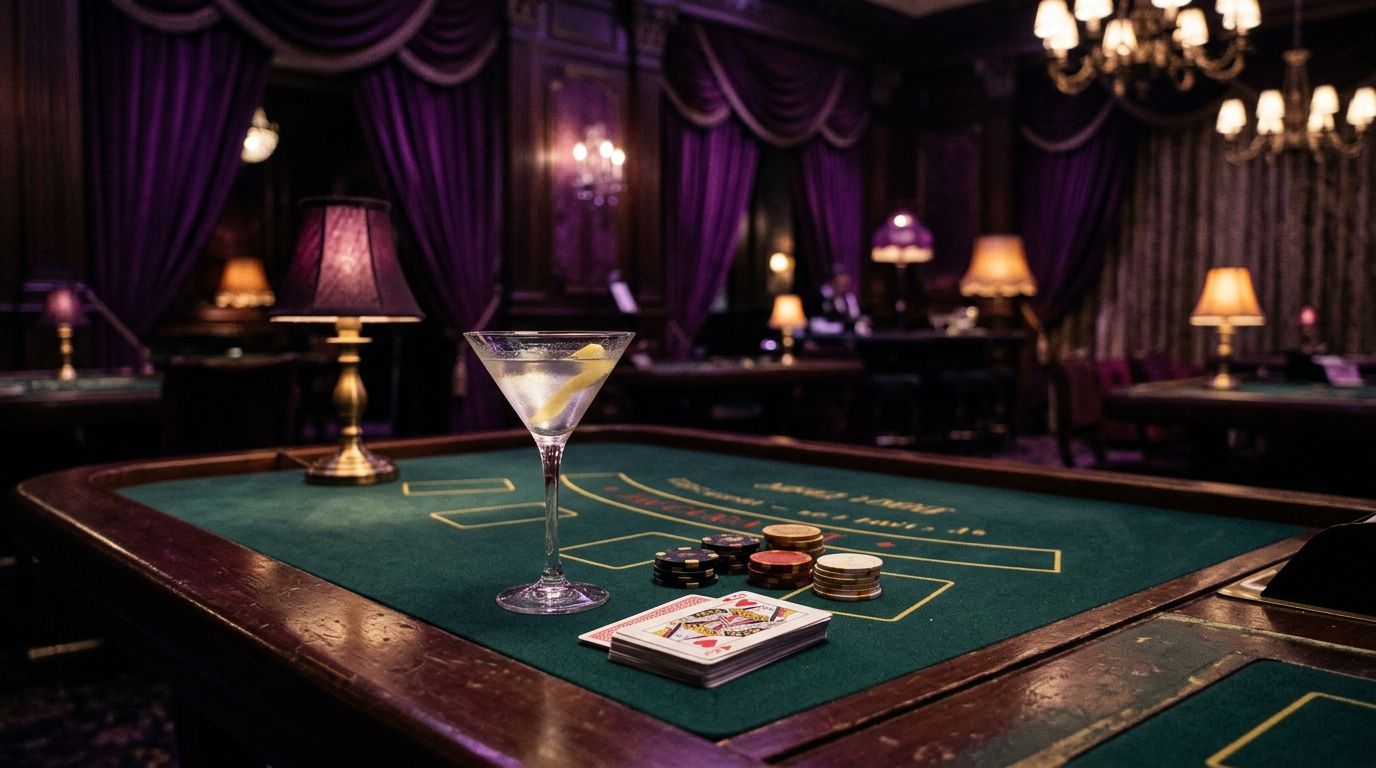
Cards, risk, and style
Casino Royale established the Bond formula before cinema made it spectacular: elegance under pressure, a mission wrapped inside a game, and glamour shadowed by violence.
Key moments
The 007 timeline
Casino Royale is published
Ian Fleming introduces James Bond, agent 007, in his debut Bond novel.
Bond reaches television
A live American TV adaptation of Casino Royale airs on Climax!, with Barry Nelson as an Americanised Bond.
Dr. No begins the EON film series
Sean Connery’s debut establishes the cinematic Bond: lethal, amused, tailored, and instantly marketable.
Goldfinger codifies the formula
The Aston Martin, gadgetry, outsized villainy, title-song swagger, and quotable cool become central to Bond’s film identity.
George Lazenby’s single mission
On Her Majesty’s Secret Service gives Bond unusual romantic stakes and a more tragic emotional register.
Roger Moore debuts
Live and Let Die ushers in a lighter, more knowing Bond shaped by 1970s pop culture and spectacle.
Timothy Dalton sharpens the edge
The Living Daylights begins Dalton’s brief but influential run, leaning closer to Fleming’s tougher, more serious spy.
GoldenEye reboots the post-Cold War Bond
Pierce Brosnan’s debut proves Bond can survive a changed geopolitical world and the modern action blockbuster.
Casino Royale resets the clock
Daniel Craig’s first film reintroduces Bond at the start of his 00 career, grounding the franchise in physical consequence and emotional damage.
Skyfall turns 50 into myth
Released in the franchise’s 50th anniversary year, Skyfall blends origin, legacy, and modern threat into one of Bond’s biggest cultural moments.
No Time To Die closes the Craig era
Craig’s final appearance gives Bond an unusually definitive ending and leaves the series ready for a new interpretation.
The next era forms
Amazon MGM Studios announced a new rights joint venture with Michael G. Wilson and Barbara Broccoli, then named Denis Villeneuve as director and Steven Knight as screenwriter for the next Bond film.
Six official cinematic Bonds
The actors changed the mission
Sean Connery
Main-series run: 1962–1967, 1971. Connery gave Bond the original film balance of menace, wit, and masculine polish.
George Lazenby
Main-series run: 1969. Lazenby made only one EON film, but On Her Majesty’s Secret Service became essential to Bond’s emotional mythology.
Roger Moore
Main-series run: 1973–1985. Moore’s Bond was debonair, comic, and often fantastical, matching an era of bigger stunts and brighter escapism.
Timothy Dalton
Main-series run: 1987–1989. Dalton pushed Bond toward intensity and moral abrasion, anticipating later “serious Bond” interpretations.
Pierce Brosnan
Main-series run: 1995–2002. Brosnan fused classic suavity with 1990s action scale and helped relaunch Bond for a post-Soviet world.
Daniel Craig
Main-series run: 2006–2021. Craig turned Bond into a wounded, evolving character across five connected films.
Note: Bond has also appeared outside the main EON continuity, including the 1967 spoof Casino Royale and 1983’s Never Say Never Again, but the six actors above are the official EON film leads.

The moving icon
Cars, travel, and the fantasy of motion
Bond’s world is never still. The series sells geography as glamour: Jamaica, Istanbul, the Alps, Las Vegas, Venice, Macau, Scotland, Matera, and beyond. Every location becomes a stage for taste, pursuit, and escape.
The style file
How Bond became a design language
Bond is more than a character; he is a visual system. Tailoring signals control. Casinos signal risk. Cars signal technology and class. Villain lairs turn architecture into psychology. Title sequences turn espionage into graphic art. Theme songs make each film feel like an event before the plot has even begun.
The series also mirrors changing ideas of power. Early films channel Cold War espionage and imperial hangover. The Moore years bend toward fantasy and comic-book scale. Dalton and Craig pull the myth back toward violence and consequence. Brosnan’s era negotiates surveillance, rogue technology, media manipulation, and the late-20th-century action machine.
That flexibility explains why Bond can be criticised and celebrated at the same time. The character carries dated assumptions from the world that created him, but the franchise’s survival depends on confronting, editing, and reframing those assumptions for each new audience.
What comes next?
The future of 007
After No Time To Die, Bond is not simply waiting for a new face; the whole proposition is being recalibrated. Amazon MGM Studios’ official announcements say Denis Villeneuve will direct the next Bond film and Steven Knight will write the script, with Amy Pascal and David Heyman producing and Tanya Lapointe executive producing. That combination suggests a prestige-scale relaunch rather than a routine sequel.
The open question is not whether Bond can return. History says he can. The real question is which Bond returns: fantasy Bond, bruised Bond, geopolitical Bond, romantic Bond, or something sharper that has not quite existed before. The answer will define whether 007 remains nostalgia—or becomes dangerous again.
Sources and factual notes
- Ian Fleming Publications: Casino Royale — publication year and novel overview.
- Official 007 site: The Films — film chronology, cast listings, and release information.
- Amazon MGM Studios joint venture announcement — current franchise rights structure.
- Amazon MGM Studios: Denis Villeneuve announcement — next-film director and producing details.
- Amazon MGM Studios: Steven Knight announcement — next-film screenwriter details.