Luxury Watches
How to Build a Watch Collection at $5,000, $25,000 and $100,000
Most “how to build a watch collection” guides are ranked wishlists. This is a set of three complete, costed portfolios built around secondary-market pricing, resale liquidity and a documented buy verdict at each budget.
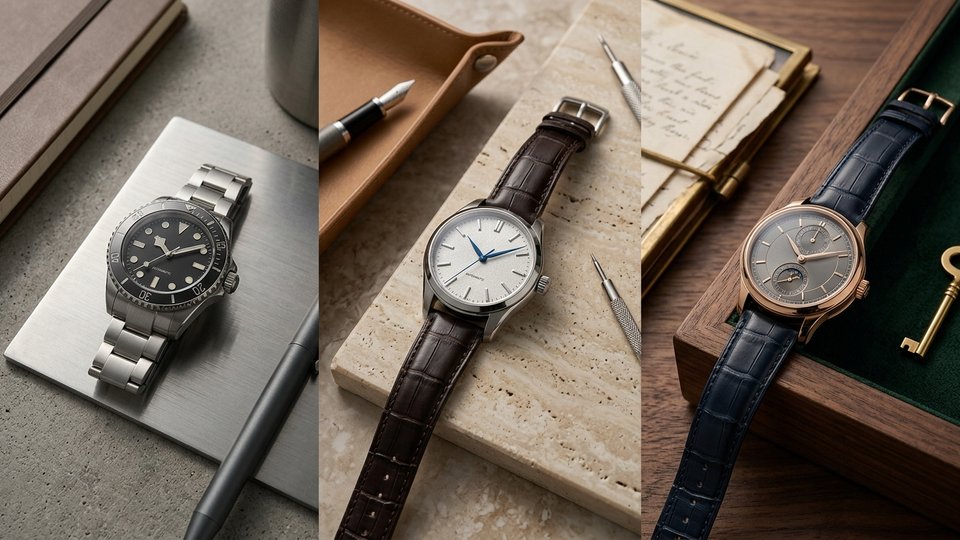
Why budget-tiered, not brand-tiered
A brand-tiered collection starts with a logo and works backward. A budget-tiered collection starts with opportunity cost: what job each watch has to do, how much capital it ties up and how quickly it can be sold without a punitive discount.
At $5,000, the constraint is coverage. One watch can be excellent; three watches have to be chosen with discipline. At $25,000, the market opens into Rolex steel, Grand Seiko Spring Drive and Cartier design without requiring speculative hype. At $100,000, the question shifts from “which watch?” to “which watch is the most efficient use of capital after insurance, service risk and resale friction?”
Methodology: how we priced this
Secondary market, not MSRP
MSRP is included only when it changes the interpretation. The working number is the market price a buyer is likely to pay for a clean, full-set or near-full-set example from a reputable seller.
Price bands
Bands are rounded from public market prices and ranges where available, then widened to allow for condition, box-and-papers status, dial configuration and seller quality.
Five-year direction
Trend direction is expressed as up, flat or down rather than as a precise return figure because published index windows and reference-level history do not always align cleanly across brands.
Liquidity rating
Easy means broad demand and a deep buyer pool. Moderate means sellable with correct pricing. Hard means specialist buyer, greater spread or longer days on market.
References reviewed for this guide include Rolex Submariner 124060 and 1680, Rolex Datejust 126234, Omega Seamaster Diver 300M, Omega Speedmaster Professional, Tudor Black Bay 58 79030N, Cartier Tank Must WSTA0041, Grand Seiko SBGA211, Patek Philippe Calatrava 5227G, Patek Philippe Aquanaut 5167A, Audemars Piguet Royal Oak 15450ST and H. Moser & Cie. Pioneer Centre Seconds.
The $5,000 Collection
At this budget, buying one excellent watch is cleaner. Building a collection is more useful if the buyer wants a rotation: one everyday steel sports watch, one dress watch and one distinct mechanical reference with enough character to avoid duplicating the first two.
| Role | Reference | Secondary price band | 5-year direction | Liquidity | Dealer path |
|---|---|---|---|---|---|
| Everyday steel sports | Tudor Black Bay 58 79030N | $2,800–$3,200 | Up / stabilizing | Easy | Crown & Caliber |
| Dress watch | Longines Flagship Heritage L4.795.4.78 | $1,000–$1,300 | Flat to slightly down | Moderate | Crown & Caliber |
| Distinct mechanical diver | Seiko Prospex SPB143 | $650–$900 | Up / volatile | Easy | Crown & Caliber |
| Estimated deployed capital | $4,450–$5,400 before tax, shipping and service allowance | ||||
The Tudor is the anchor because the Black Bay 58 has a deeper buyer pool than most enthusiast alternatives at this price. The Longines gives the collection a thin, formal profile without forcing a Cartier premium into a tight budget. The Seiko is not there to impress by brand hierarchy; it is there because a mechanical, well-proportioned diver with consistent demand is easier to own than an obscure complication with a narrow resale audience.
The $25,000 Collection
This is the first budget where brand, finishing and resale depth can coexist. The portfolio below avoids paying for scarcity theater and instead uses four roles: Rolex liquidity, Grand Seiko finishing, Cartier design and Omega utility.
| Role | Reference | Secondary price band | 5-year direction | Liquidity | Dealer path |
|---|---|---|---|---|---|
| Liquidity anchor | Rolex Datejust 36 126234 | $11,100–$13,800 | Up, with dial-specific spread | Easy | Bob’s Watches |
| Finishing / movement | Grand Seiko SBGA211 “Snowflake” | $4,200–$5,000 | Up / improving | Moderate | Crown & Caliber |
| Design dress watch | Cartier Tank Must Large WSTA0041 | $2,900–$3,400 | Flat to slightly up | Easy | Crown & Caliber |
| Waterproof daily / travel | Omega Seamaster Diver 300M 210.30.42.20.03.001 | $4,000–$4,800 | Up / broadening | Easy | Crown & Caliber |
| Estimated deployed capital | $22,200–$27,000 before tax, shipping and service allowance | ||||
The Datejust is selected over a Submariner here because the budget has to fund the rest of the portfolio. A modern Submariner can be rational if purchased at a fair secondary-market price, but it compresses the remaining choices. The Grand Seiko is the watch in this tier that most changes the wearing experience: Spring Drive, case finishing and dial work are not replicated by adding another Swiss steel sports watch.
The $100,000 Collection
At $100,000, the collection should not simply scale up the same steel-sports logic. The portfolio has to balance institutional demand, recognizable high-end design, one vintage allocation and one independent or less obvious position that is bought for entry discipline rather than hype.
| Role | Reference | Secondary price band | 5-year direction | Liquidity | Dealer path |
|---|---|---|---|---|---|
| Patek anchor | Patek Philippe Calatrava 5227G | $26,000–$31,000 | Flat to up | Moderate | Crown & Caliber |
| AP design anchor | Audemars Piguet Royal Oak 15450ST | $34,000–$40,000 | Up, below pandemic-peak sensitivity | Easy | Crown & Caliber |
| Vintage allocation | Rolex Submariner 1680 | $18,000–$23,000 | Mixed / condition-led | Moderate | Bob’s Watches |
| Independent allocation | H. Moser & Cie. Pioneer Centre Seconds | $10,000–$13,500 | Flat to up by variant | Hard | Crown & Caliber |
| Estimated deployed capital | $88,000–$107,500 before tax, shipping, insurance and service reserve | ||||
A Patek Philippe Aquanaut 5167A can absorb most of this budget by itself; public market pages put entry steel Aquanaut pricing around the high-$60,000s in August 2026. That is liquid and recognizable, but it turns the collection into a single concentrated bet. The Calatrava is less obvious, less liquid and less hype-sensitive, which is why the rest of the portfolio can carry the sports-watch exposure.
What We Would Buy Today
$5,000 tier
Tudor Black Bay 58 79030N. It is the most liquid foundation at this price and leaves enough capital for a measured two-watch expansion.
$25,000 tier
Grand Seiko SBGA211. It provides the greatest improvement in finishing and movement experience per dollar, without requiring a premium for steel Rolex access.
$100,000 tier
Patek Philippe Calatrava 5227G. It is not the easiest flip, but it is the cleanest anchor if the goal is a diversified high-end collection rather than one overconcentrated sports model.
Mistakes People Make at Each Budget
At $5,000: buying three compromises
The collection should not be built only to hit the number three. If the third watch requires buying a weak reference with poor resale, hold the cash.
At $25,000: confusing market access with market value
A Rolex allocation is useful only if the configuration is liquid and the purchase price is not above the observable market band.
At $100,000: underestimating service and insurance
A $100,000 collection should have a documented service reserve, scheduled insurance and written purchase documentation for every reference.
Across all three tiers, the recurring mistake is buying for logo recognition instead of liquidity. A watch that is difficult to sell at a fair price in three years is a worse purchase than a cheaper watch with a deeper buyer pool.
FAQ
Do luxury watches hold resale value?
Some do, but resale value is reference-specific. Steel Rolex, select Patek Philippe and certain Audemars Piguet Royal Oak references usually have deeper buyer pools than obscure complications or fashion-led limited editions. Liquidity is not the same as appreciation.
Should I insure a watch collection?
Yes, once replacement value is material. A scheduled personal articles policy or specialist jewelry/watch policy should document serial numbers, purchase invoices, appraisals and photographs. Re-appraise after major market moves.
Is buying used better than buying new?
For many references, used is the rational starting point because the first owner has already absorbed the retail-to-market spread. The exception is a high-demand retail allocation that can be purchased at MSRP without bundling or relationship spending.
How often should price data be refreshed?
Refresh price data quarterly and immediately before making a major purchase. Secondary watch markets can move quickly around discontinued references, new releases and changes in authorized-dealer supply.