
 cEDH
cEDH
Partner Commanders Are Inherently Broken, Even When the Cards Aren’t
Commander has never been a perfectly balanced format, and cEDH players are usually the first to admit it. We play with fast mana, free interaction, compact win conditions, and engines assembled from decades of Magic cards. Nobody sits down at a competitive table expecting every commander to have an equal chance of winning. Even within that context, however, I have always believed the partner mechanic is inherently broken. That does not mean every partner commander is individually overpowered, and there are plenty of partner combinations that would struggle at an average casual table, never mind a cEDH pod. The problem is not necessarily the strength of every card with partner printed on it. The problem is what the mechanic gives you before the game has even started.
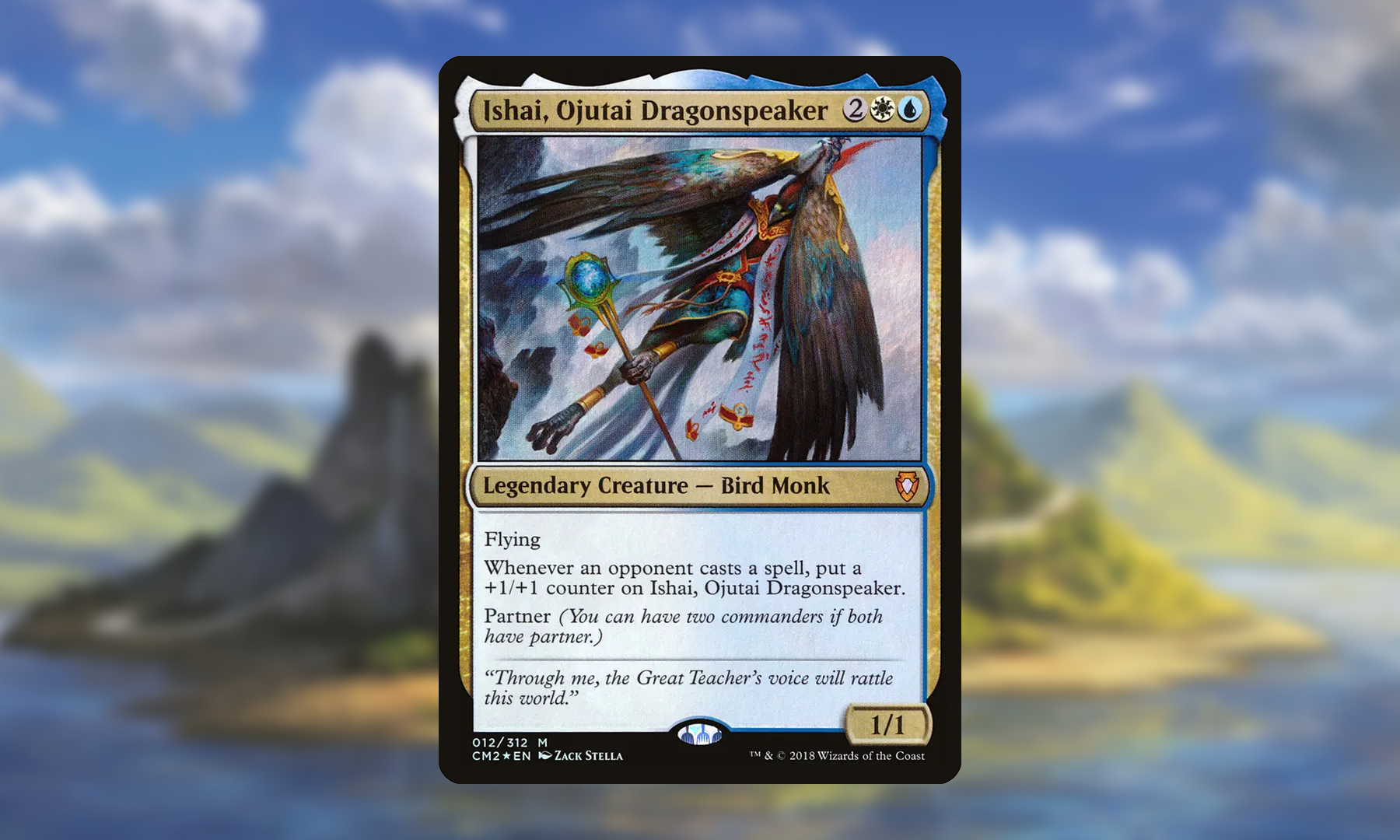
A partner deck gets two guaranteed cards in the command zone, a combined color identity, separate commander taxes, a smaller randomized library, and the ability to divide the responsibilities of a traditional commander between two specialized pieces. That is a collection of structural advantages that normal commanders simply do not receive. Blue Farm, also known as Tymna/Kraum or T&K, shows how oppressive partner can become when both commanders are legitimate engines. RogSi, Rog/Thras, TnT, Tymna/Dargo, Rog/Ishai, and Malcolm/Vial all show different versions of the same problem: partner does not merely give you another commander. It lets you customize your command zone, and compensate for your deck's weaknesses.
Color Identity Is Supposed to Be a Real Restriction
One of the most important decisions in commander is choosing which colors you are willing to play. Every commander gives you access to certain parts of the color pie, but that access is supposed to come with consequences. A mono-blue commander gives you countermagic, card draw, and stack interaction, but it cannot play black tutors or red rituals. A Rakdos commander gets access to explosive mana and efficient tutors, but it has fewer ways to interact with spells on the stack. Those weaknesses are part of commander’s deck-building system. Choosing a commander is not only about finding the strongest ability; it is also about deciding which tools you are prepared to give up in exchange for that ability.
The partner mechanic significantly overcomes that restriction. Technically, partner decks still follow color-identity rules. They are not illegally playing cards outside their commanders’ colors. In practice, however, they can use one commander for its abilities and the other partly as a way to unlock additional colors. With a normal commander, moving from two colors to three or four usually means finding an entirely different legendary creature. You may have to accept weaker text, a higher mana value, or a commander that does not fit the strategy as cleanly. With partner, you can preserve the commander you actually want and pair it with another card that fills in the missing colors. The second commander is therefore more than a spell. It is also a deck-building permission slip.
Partner Decks Start With an Extra Guaranteed Resource
A regular commander deck contains 100 cards, including its commander. After drawing an opening hand of seven (unless you're unfortunate like I usually am), a single-commander deck has seven cards in hand, one commander in the command zone, and 92 cards left in the library. A partner deck has seven cards in hand, two commanders in the command zone, and 91 cards left in the library. It would not be completely accurate to say the partner player starts with eight cards in hand, since commanders are public information, must be cast, and cannot be used in every way that a card in hand can. But they are still guaranteed, castable resources that the player can plan around from the opening turn.
The partner player begins with nine. More importantly, that ninth card is not random. It was deliberately selected during deck construction and chosen specifically to complement the other commander. Partner therefore offers something better than ordinary card advantage: guaranteed card access. The second commander cannot be missed in a draw step, cannot begin on the bottom of the library, does not need to be found with a tutor, and cannot be permanently taken away through ordinary hand disruption. It is there every game, and that reliability is especially powerful in a singleton format built around variance. In the case of a turbo RogSi deck, Rograkh is cast for 0, immediately enabling a Mox Amber, Deflecting Swat or Fierce guardianship. Better yet, you can also generate 3 mana on turn 1 by sacrificing Rograkh to a Dark Ritual giving you 3 black mana. There's a reason why it's a turbo deck after all.
The Smaller Library Is Not Huge, but It Still Matters
I would not pretend that reducing the post-opening-hand library from 92 cards to 91 transforms every partner deck into a perfectly consistent machine. The raw statistical difference is small, and it would be easy to overstate it. The meaningful part is what happened to that card. The partner player did not simply remove one random card from the deck. They moved a specifically selected creature from the randomized library into the command zone, where it is guaranteed to be available. That gives the deck one fewer unknown draw and one more predetermined resource from the beginning of the game.
Viewed in isolation, the deck-thinning advantage is marginal. Combined with everything else partner provides, it becomes another way the mechanic reduces variance. Commander is a singleton format, and consistency is supposed to cost something, usually in the form of tutors, redundant effects, or card selection. Partner improves consistency before any cards have been drawn or cast. The second commander does not just make the library one card smaller, it replaces a random draw with a known resource that the deck was specifically built to exploit.
Partners Can Make Mulligans Better
This may be the most underrated advantage of the entire mechanic. An opening hand in cEDH has several jobs to perform. It needs mana, but it may also need interaction, card advantage, an engine, protection, or a realistic path toward winning the game. A normal commander can cover one or two of those needs, depending on its design. Partners can cover several of them at once. When the command zone already contains a cheap enabler and a card-advantage engine, the opening seven no longer needs to provide either one, which allows the player to mulligan more aggressively for fast mana, tutors, protection, or a specific early-game plan.
That makes partner’s card advantage more complicated than simply starting with an extra card. The mechanic improves the quality of the seven cards you keep. A Blue Farm player does not need to keep a slow hand simply because it contains a value engine, because the value engines are already sitting in the command zone. The player can mulligan for acceleration and interaction, knowing that Tymna or Kraum can rebuild if the opening burst does not win the game. RogSi can be even more aggressive because Rograkh is already a free creature while Silas provides access to the full Grixis card pool. Partners reduce the number of jobs the opening hand needs to perform, which is a massive advantage in a format where the first three turns often determine the entire game.
Two commanders Can Divide One commander’s Responsibilities
A traditional commander is one complete package. It needs to provide the correct colors, support the deck’s strategy, and be realistically castable. Ideally, it also produces cards, mana, or some other form of value. It is difficult for one card to do all of that without some kind of weakness, and those weaknesses are usually where the format creates meaningful trade-offs. A commander with excellent text may be limited to fewer colors, while a commander with broad color access may be expensive, narrow, or less efficient.
Partner lets two cards split the work. One commander can provide card advantage while the other provides colors. One can be a free sacrifice enabler while the other adds blue and black to the deck. One can be useful during the opening turns while the other takes over later. This removes much of the compromise involved in choosing a commander. Instead of asking which one legendary creature best supports the deck, the partner player can ask which two command-zone pieces create the most efficient package. That is a fundamentally different deck-building proposition, and it is why weaker-looking partners can still be extremely powerful. A partner does not need to function as an entire commander by itself. It only needs to perform one role efficiently enough to complement the other card.
Blue Farm Puts an Entire Value Package in the Command Zone
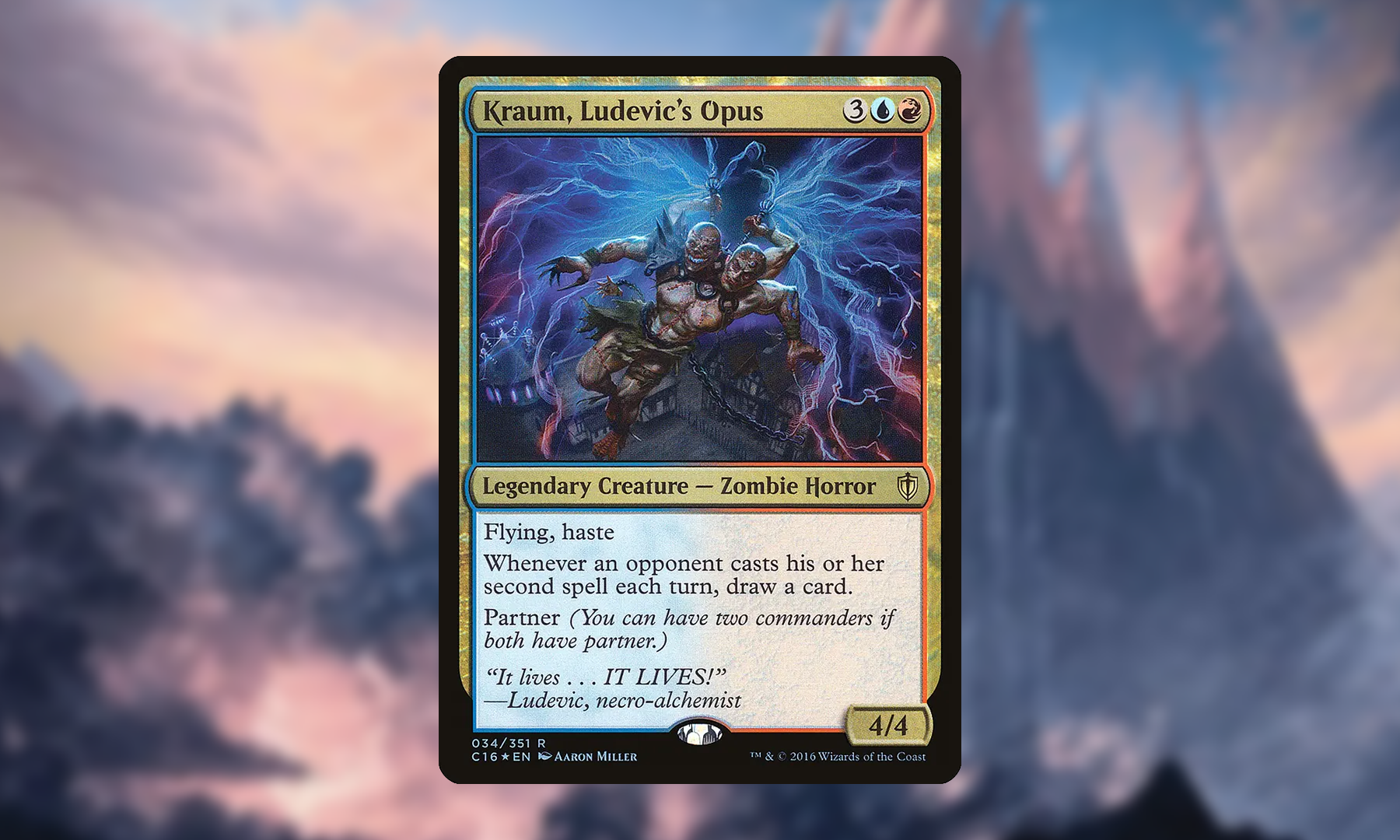
Blue Farm is the clearest example of what happens when both partners are independently strong. Tymna the Weaver gives the deck an inexpensive source of repeatable card advantage and naturally rewards the creatures cEDH decks already want to play, whether those are mana dorks, hatebears, or utility creatures. Those creatures do not need to deal meaningful damage. They only need to connect, after which Tymna can convert those attacks into cards. Kraum covers a completely different angle. He is an evasive, hasty threat that draws a card whenever an opponent casts their second spell in a turn, and at a cEDH table that condition is barely a restriction. Developing mana, tutoring, interacting, and attempting wins all tend to involve multiple spells.
The important part is that neither commander depends on the other. When the board is open, Tymna rewards attacks. When combat is locked down, Kraum can draw cards simply because opponents are playing the game. Tymna comes down early, while Kraum provides a larger midgame body and immediate pressure. If Tymna is removed, the deck has not lost access to command-zone card advantage because Kraum is still available. If Kraum is countered or becomes too expensive, Tymna remains the cheaper engine. Most commander decks must draw their backup engine from the library. T&K starts with both engines revealed.
The pair also gives the deck access to white, blue, black, and red, yet its controller never has to cast a four-color spell to access that card pool. Tymna asks for white and black, while Kraum asks for blue and red. The deck receives nearly the entire cEDH color pie while dividing the casting requirements between two separate creatures. That is one of partner’s most important advantages: the deck-building benefits of four colors without the same casting burden as a four-color commander. Blue Farm is not powerful only because Tymna is good or because Kraum is good. It is powerful because the pairing combines two engines, two points on the mana curve, four colors, and a built-in backup plan.

Strong partner Shells Prove the Problem Is Broader
The argument should not stop with Blue Farm and RogSi. EDHTop16’s cEDH metagame page lists multiple partner pairings among prominent commander choices, including Blue Farm, Rog/Thras, Rog/Si, TnT, Dargo/Tymna, Rog/Ishai,and Dog/Thras. That spread matters because the decks are not all doing the same thing. Some are turbo decks, some are midrange value decks, some are creature-combo decks, and some are tempo or pressure shells. The common thread is that partner lets each list assemble a command zone that covers more than one job at once.
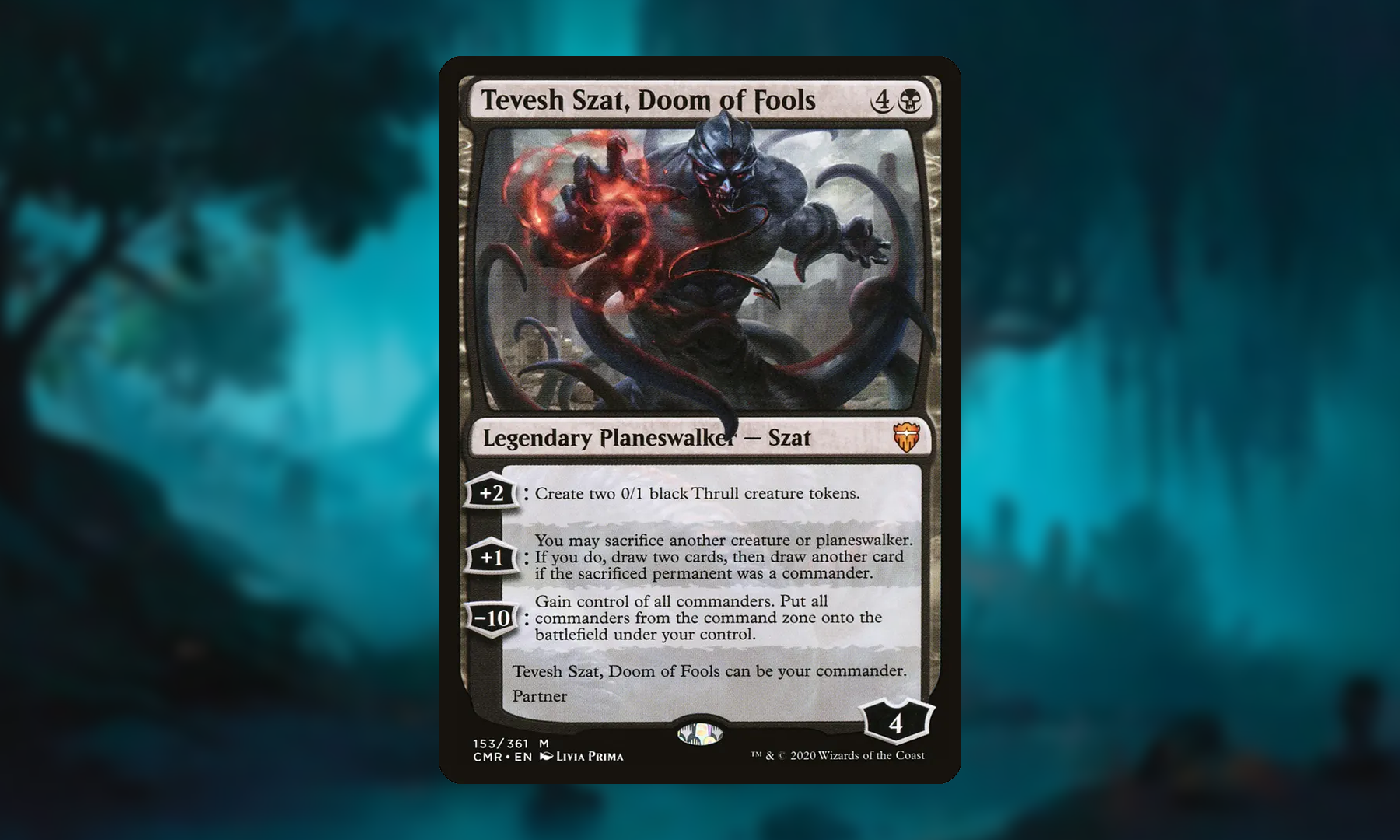
Thrasios/Tymna, often shortened to TnT, is one of the cleanest examples of partner turning flexibility into inevitability. Tymna draws cards, while Thrasios gives the deck a mana sink, an outlet for infinite mana, and access to blue and green. RogThras works from a different angle: Rograkh supplies a free body and speed, while Thrasios supplies blue interaction, green mana development, and a late-game outlet. Dargo/Tymna and Dargo/Thrasios show another version of the same issue because Dargo converts expendable permanents into a huge discounted threat or combo piece while the partner fills in colors, cards, or an outlet.
The same pattern appears in partner decks that are less turbo oriented. Ishai/Rograkh combines an evasive scaling threat with a zero-mana enabler, giving the deck both pressure and early resource conversion (although the main power comes from having access to white and blue). Malcolm/Vial Smasher turns two individually narrow cards into a Grixis command zone that can pressure the table, generate treasure through Malcolm, and benefit from Vial Smasher’s incidental damage. Even when a specific pair is not the best deck in a given month, the mechanic keeps producing competitive shells because each commander only needs to solve part of the puzzle. That is the clearest sign that the problem belongs to partner itself, not just to one famous deck. There are very few commanders can have abilities and color pies that can compete with partners.
RogSi Shows That a partner Does Not Need Strong Text to Be Broken
RogSi demonstrates the partner problem from the opposite direction. Rograkh, Son of Rohgahh is a zero-mana 0/1 with first strike, menace, and trample, none of which makes him a meaningful combat threat in cEDH. What matters is that he costs zero and begins every game in the command zone. That makes Rograkh a guaranteed creature, commander, and legendary permanent that can be cast without spending mana or using a card from the opening hand.
A normal deck that wants a disposable zero-mana creature must put it in the 99 and then draw it. RogSi receives one automatically. Silas Renn contributes blue and black to Rograkh’s red, giving the deck Grixis color identity. His combat-damage ability can occasionally matter, but it is not the primary reason many RogSi lists choose him. He provides the colors the deck wants while remaining a legal partner for Rograkh. This is exactly what I mean when I say partner lets two commanders specialize. Rograkh provides speed, a free body, and immediate command-zone utility, while Silas provides two additional colors and some secondary value. Neither card needs to carry the entire strategy, allowing the other 98 cards to focus on executing a fast Grixis game plan.
Rograkh also makes fast mana and fast interaction dramatically easier to access, which is why he makes turbo strategies so much better. A free commander turns Mox Amber on without spending mana, gives sacrifice-based acceleration and tutor effects like Culling the Weak and Diabolic Intent reliable material, and creates a body for lines that need a creature or a legendary permanent immediately. At the same time, he helps enable commander-dependent interactions such as Fierce Guardianship, Deflecting Swat, and Deadly Rollick without forcing the deck to tap out for a real commander first. The result is not just speed; it is protected speed. RogSi can commit mana to a turbo line while still having a commander on board for free interaction, which makes the deck’s fastest hands much harder to punish.
The tournament data points in the same direction. EDHTop16’s Rogh/Si page lists the pair among top-performing cEDH commanders, with its indexed commander result showing a 4.11% meta share and 19.90% conversion rate at the time of review. MTGTop8 likewise has Rog/Si cEDH event pages in its database, including events indexed at 16 players, 26 players, and 41 players. Those numbers do not prove that every RogSi pilot is favored in every pod, but they do show that the deck is not a theoretical abuse case. Rograkh’s free body, Silas’s Grixis color access, and the partner rules translate into real tournament presence.
RogSi proves that a commander does not need to draw cards or contain an obvious combo to create a huge advantage. Mana value, color identity, and guaranteed availability can be enough. The deck effectively starts with a free game piece that cannot be removed from its opening hand because it was never in the hand to begin with. That is an enormous advantage in a format where early mana conversion, sacrifice outlets, commander-dependent interaction, and compact combo lines can all turn a zero-mana creature into something much more valuable than its printed text suggests.
Separate commander Taxes Make Removal Less Effective
Commander tax is supposed to limit repeated access to a guaranteed card. With partners, however, that tax is tracked separately. Removing Tymna makes Tymna more expensive, but it does not increase Kraum’s cost. Removing Rograkh does not tax Silas, and countering Silas does not affect the next Rograkh cast. This gives partner decks another form of resilience because they do not always need to recast the commander that was answered. They can pivot to the other one and continue developing while waiting for a better moment to redeploy the first.
A normal commander-centric deck can be slowed dramatically by killing its commander twice. A three-mana commander becomes five mana and then seven, which can make the entire deck stumble. A partner deck has another untaxed resource waiting in the command zone. Opponents are not dealing with one repeatable threat but with two separate commander-tax progressions. That puts removal in an awkward position. Answering the first commander may still be correct, but it does not necessarily shut off the partner player’s command-zone plan, and repeated removal does not punish the deck as efficiently as it punishes a traditional commander strategy.
Partners Give Decks a Built-In Mana Curve
A commander is also a guaranteed way to spend mana. With one commander, that option exists at one point on the curve. If the commander costs five or six mana, it may offer nothing during the opening turns. If it costs one or two, it may be less impactful later. Partners can cover both periods. A cheap partner can be deployed early, while the second commander provides a later play. If one is poorly positioned, the player can cast the other, and if the opening hand contains acceleration, the deck has multiple guaranteed ways to convert that mana into development.
Blue Farm demonstrates this clearly. Tymna is the early engine, while Kraum is the larger midgame threat. RogSi pushes the concept to its extreme because Rograkh costs zero, meaning the deck has a guaranteed turn-zero resource before it has even played a land. Other shells show the same curve-splitting advantage in different ways: Dargo decks can convert early artifacts and creatures into a discounted threat, while Thrasios shells can turn excess mana into cards later. The partner player therefore begins with more options at more points on the curve. That flexibility is a form of card advantage even when it does not immediately produce additional cards. Having more viable actions means fewer turns where the deck is forced to pass because it drew the wrong half of itself.
A Cheap partner Makes commander-dependent Cards Better
Cards such as Fierce Guardianship, Deflecting Swat, and Deadly Rollick become dramatically better when their controller has a commander on the battlefield. Partner makes satisfying that condition easier. A deck with one expensive commander may be unable to deploy it early enough to turn on free interaction, while a partner deck can use its cheaper commander for that purpose even when the second commander is the more important engine. Rograkh is the most obvious example because his first cast costs nothing, allowing him to immediately satisfy effects that care about controlling a commander without consuming mana from the turn.
That means the partner can contribute value before its printed abilities are even relevant. The same principle applies to cards that care about casting, sacrificing, attacking with, or otherwise controlling a commander. With two available, the deck is more likely to have access to whichever game object it needs. This is not printed directly in the partner reminder text, but it is an advantage created by the surrounding commander rules. A cheap partner effectively strengthens an entire category of commander-dependent cards while also remaining a guaranteed resource in its own right.
“Replace this line with a bold, memorable quote that gives readers a moment to pause.”
Partner Creates a Combinatorial Design Problem
There is also a larger design issue with unrestricted partner. A normal commander can mostly be evaluated as one card. A partner must be evaluated alongside every other unrestricted partner that exists now or could be printed later. Every new partner creates new combinations with the existing pool, which makes balancing the mechanic increasingly difficult. A commander that appears fair in isolation may become exceptional when paired with the cheapest available partner, the strongest card-advantage engine, or the exact colors needed to complete a strategy.
The long-term problem is that unrestricted partner does not lock commanders into predetermined pairs. Players can mix and match them, turning the command zone itself into a modular deck-building system. “Partner with” is much safer because the pairing is fixed, allowing designers to know exactly which two cards can appear together. Unrestricted partner instead asks designers to predict how every partner will interact with every other partner across the life of the format. The strongest combinations are not always the ones that look most flavorful or obvious. They are the ones that divide resources, colors, and utility most efficiently. That is why the competitive examples are so varied: Blue Farm, TnT, RogSi, Rog/Thrasà, Dargo shells, Ishai shells, and Malcolm shells all exploit different parts of the same modular command-zone system.
Not Every partner Deck Is Overpowered
The obvious counterargument is that plenty of partner decks are bad, and that is true. Two weak commanders do not automatically make a strong deck. Partners also reveal more information to the table, and having access to two commanders does not mean the player will always have enough mana to cast both. There is also at least one area where two commanders can be worse: commander damage is tracked separately, so damage from both partners does not combine toward the 21-damage threshold. But let's be real. The amount of competitive decks that care about commander damage are slim to none (unless of course an infinite turn combo strategy provides this)
None of that changes the underlying argument. A mechanic can be inherently advantaged without every card using that mechanic being competitively viable. The claim is not that any random partner pairing will beat the best standalone commanders. The claim is that partner provides structural benefits that must be overcome through card design. In other words, partner commanders need to be weaker than comparable standalone commanders because the mechanic itself supplies so much value. When the individual cards are also efficient, as with Tymna, Kraum, Thrasios, Rograkh, Dargo, Malcolm, or Silas, the result becomes much harder to justify.
Partner Removes Too Many of commander’s Normal Trade-Offs
Commander is built around access and restriction. You receive one legendary creature that is available throughout the game, but its color identity limits the rest of your deck. You can recast it after removal, but commander tax makes doing so increasingly expensive. You always have access to your commander, but every other card must be drawn from a 99-card singleton library. Partner softens all of those restrictions at once. You receive two command-zone cards instead of one, combine their color identities, remove another card from the randomized library, track commander tax separately, improve opening hands because more essential functions are guaranteed, and gain two casting options that can divide early-game and late-game roles.
Any one of those advantages might be defensible. Taken together, they create a mechanic that begins every game ahead of a traditional commander before either player has made a decision. Blue Farm shows the value ceiling: two genuine card-advantage engines, four colors, and resilience against removal. RogSi shows the turbo floor: one commander can contribute enormous value simply by costing zero, while the other completes the desired color identity. TnT, Rog/Thras, Dargo/Tymna, Rog/Ishai, and others fill in the middle by proving that partner can support grindy, explosive, creature-based, tempo, and pressure-oriented strategies. Those decks are not exceptions that happen to abuse an otherwise fair mechanic. They are the clearest expressions of what partner was always capable of doing.
Partner commanders are not inherently broken because every partner card is too strong. They are inherently broken because the mechanic allows players to avoid too many of the compromises commander is supposed to demand. In cEDH, where consistency, efficiency, and guaranteed access are everything, those compromises matter.
The solution depends on how hard a rules committee wants to push back. The cleanest answer is to avoid printing unrestricted partner again and rely on fixed “partner with” pairs when two-card command zones are desired. That lines up with Mark Rosewater’s own Blogatog commentary, where he said his “first hunch” for a fun mechanic that was a mistake in retrospect was partner, and that Wizards would likely have been happier if partner had only appeared on monocolor cards. That admission matters because it frames the issue as a systemic design risk, not just a cEDH complaint. A stronger competitive fix would be banning or restricting the worst partner pairings, making commander tax shared across partner commanders, having partner decks start with 6 cards instead of 7, or requiring a partner deck to choose only one commander to begin in the command zone. A softer approach would be a points-list or tournament-specific rule that taxes the structural advantage without deleting casual partner decks. Whatever option is chosen, the important thing is to treat partner as a rules-level advantage rather than pretending the problem is only partners as individual cards.
Comments
Join the conversation
Share a thoughtful response, question, or note for the community.
Log in to write a message
Please log in to your profile before writing and posting a comment.
Comments
Loading comments…
No comments yet. Be the first to start the conversation.