
Feature
Assassin's Creed Black Flag's sea shanties are still the best part of the game
I hate to sail on this rotten tub — but I love to hear it.
Remember, in 2021, when TikTok was suddenly awash with sea shanties? It remains one of the most inexplicable, albeit wholesome, online crazes of the pandemic era: a tide of videos of young men — mostly men — with beards and nice sweaters adding layers of harmonies to ancient seamen's work songs.
For a hot minute, these a cappella folk songs about a sailor's sorry lot were the coolest music on the planet, and all because a Scottish singer called Nathan Evans uploaded a video of himself singing Wellerman, a whaler's shanty originating in New Zealand. The internet did what the internet does best when it is briefly, miraculously, not being terrible: it joined in. Basses rumbled beneath tenors. Fiddles appeared. Harmonies stacked like barrels in a hold. Everyone, trapped indoors and missing the sound of other people, suddenly wanted to sing about sugar and tea and rum.
It was a fun moment. It was also a reminder that Ubisoft had beaten TikTok to it by the better part of a decade.
Assassin's Creed IV: Black Flag understood the appeal of shanties before they became a social media punchline, a lockdown comfort, and a streaming-service curiosity. More importantly, it understood them as more than collectible audio logs. The shanties in Black Flag do not merely decorate the Caribbean; they transform it. They turn a long, mechanically repetitive voyage into something with breath, humor, labor, and longing. They are the reason I can still remember the game's sea lanes more vividly than its plot.
The Jackdaw is a lousy commute with an unbeatable soundtrack
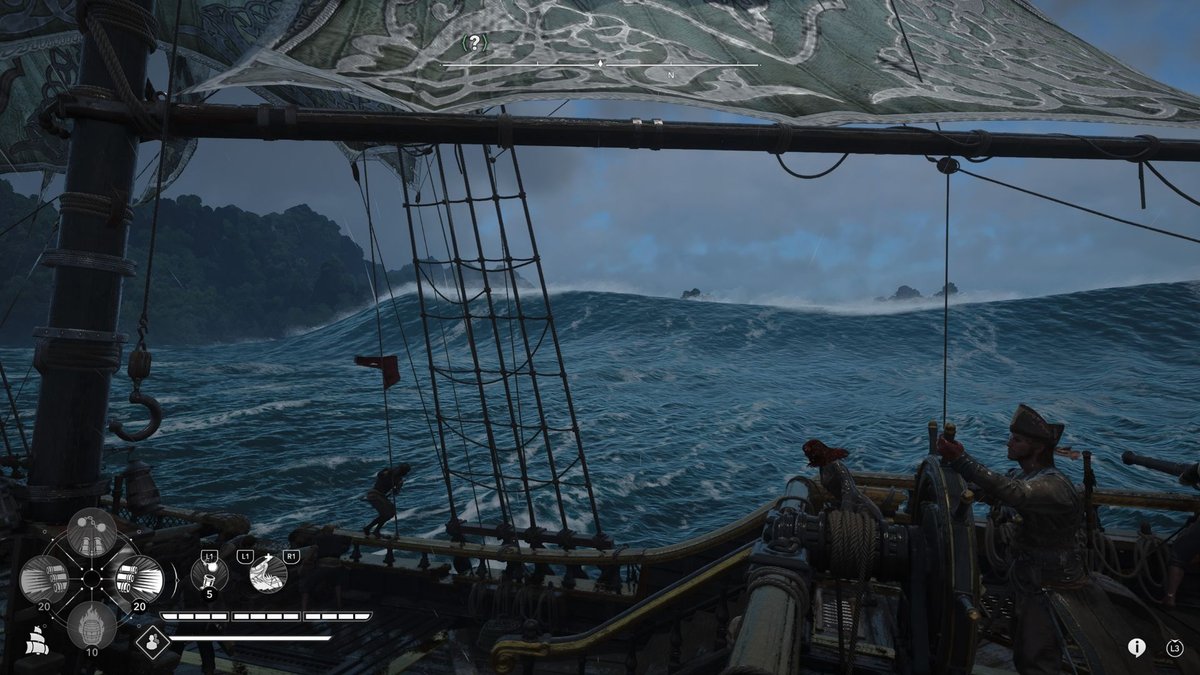
I have never loved sailing in Black Flag as much as I love the idea of sailing in Black Flag. In theory, the Jackdaw is freedom incarnate: a stolen brig cutting across turquoise water, islands rising on the horizon, treasure maps in your pocket, naval forts begging for trouble. In practice, it is also a damp commute between map icons. Wind, waves, enemy patrols, restricted zones, upgrade requirements, and the constant need to stop being cinematic so you can loot enough metal to make your cannons slightly less embarrassing — this is the business of piracy once the postcard fades.
The shanties are what save it. They do not erase the slog; they metabolize it. When the crew launches into “Leave Her, Johnny,” “Roll, Boys, Roll,” “Randy Dandy Oh,” or “Drunken Sailor,” the ship stops feeling like a vehicle and starts feeling like a workplace full of tired men trying to get through the day. Suddenly the distance to your objective matters less than the rhythm carrying you there. The waves become percussion. The rigging becomes scenery for a chorus. Even the rotten tub starts to feel loved, if only because everyone aboard has agreed to complain about it in tune.
The genius of Black Flag is that its best music sounds like it belongs to the crew before it belongs to the player.
That is a subtle but crucial distinction. So much open-world music is composed to flatter your adventure from above: swelling strings for discovery, drums for danger, a mournful motif for the hero's inner burden. Black Flag's shanties come from inside the fiction. They are diegetic without feeling gimmicky, interactive without needing a button prompt, and nostalgic without requiring the player to be a scholar of maritime song. You collect them as fluttering pages, yes, but once learned they belong to the sailors. Edward Kenway may be the protagonist. The crew gets the chorus.
Work songs for a game about work
Sea shanties were work songs before they were vibes. Their call-and-response structures helped sailors coordinate labor: hauling, heaving, pumping, turning, enduring. That is part of why their TikTok revival felt so oddly right in 2021. The world was full of isolated people trying to remember how collective effort sounded. One voice invited another, then another, until the song became an improvised community.
Black Flag taps into the same principle, but through play. Its sea is not empty spectacle; it is a chain of tasks. Sail there. Spyglass that. Brace for impact. Board the schooner. Repair the hull. Dive the wreck. Upgrade the mortars. Repeat until the horizon has been efficiently converted into checkmarks. If you strip away the palm trees and cannon smoke, much of Black Flag is a game about work.
That should make it tedious. Sometimes it does. But the shanties give the work a social texture. The crew is not silent cargo waiting for the player to trigger the next mission. They grumble, celebrate, harmonize, and fill dead air with songs that are themselves about drudgery, desire, bad luck, home, booze, pay, and quitting. “I thought I heard the old man say / Leave her, Johnny, leave her” is funny when you are gliding through a sunset. It is funnier when you have just scraped the Jackdaw across another reef because the minimap distracted you.
This is why the shanties remain Black Flag's secret design masterstroke. They are not just historically flavored ambiance. They are a pressure valve for repetition. They give the player permission to enjoy the journey even when the game is plainly stretching that journey out. They turn traversal from waiting into listening.
Ubisoft's pirate fantasy needed rough edges
There is plenty in Black Flag that feels compromised by the broader Assassin's Creed machine: eavesdropping missions that drag a pirate adventure back toward old habits, modern-day framing that interrupts the salt spray, and a familiar appetite for map clutter. Its pirate fantasy is often at its best when it forgets it is also obligated to be franchise infrastructure.
The shanties cut through that friction because they feel gloriously unpolished. Not badly performed — the recordings are full of personality — but communal, rowdy, and weather-beaten in spirit. They do not sound like theme music for a brand. They sound like men trying to keep time while the deck bucks beneath them. They make the Caribbean feel lived in rather than merely rendered.
They also complicate the game's power fantasy in a way the script does not always manage. Pirate media loves freedom, swagger, and rebellion; shanties remember exhaustion. They are songs of movement, but rarely of comfort. They carry jokes, threats, homesickness, and resignation. In a game where you spend dozens of hours making the Jackdaw stronger, richer, and deadlier, the crew's songs keep reminding you that life at sea is still cold, cramped, dangerous, and badly paid. That tension is the point. I hate to sail on this rotten tub — but I love to hear it.
The pandemic made the old trick obvious
The ShantyTok boom made some people talk about sea shanties as if they had been rediscovered from a sealed vault. In reality, their appeal had never vanished. Folk circles, maritime museums, pub sessions, historical reenactors, and game soundtracks had kept them moving. What TikTok revealed was not that shanties were newly good. It revealed how instantly legible their architecture remains. One person starts. Others answer. The song becomes sturdier because more voices carry it.
That is exactly the fantasy Black Flag sells every time the Jackdaw gets underway. You are not listening to a polished solo performance. You are listening to a crew become a crew. The game invites you to feel lonely in a wide ocean, then solves that loneliness with voices. It is an old trick, and it still works.
Maybe that is why the songs have aged better than many of the systems around them. Naval combat remains thrilling in bursts, but familiar in structure. The map is generous, but busy. The story has charm, but it is not the part I hum years later. The shanties, though, remain immediate. They ask nothing except that you stay aboard a little longer.
The best collectible is the one you actually use
Open-world games are full of things we collect out of obligation. Feathers, fragments, trinkets, relics, documents, currencies, icons that exist to be removed. Black Flag's song sheets are different because their reward feeds directly back into the texture of play. Find one, and the world sounds better. Chase a scrap of paper across a rooftop, and the next voyage gains another possible mood.
That is elegant design. It is also why Black Flag's shanties have outlived so much of the game's checklist. They are collectibles with memory attached. Players do not merely remember that they found them; they remember when the crew sang them. They remember sailing too far because the song was not over. They remember arriving at a mission marker and waiting, just for a verse, before pressing on.
In 2021, TikTok briefly turned the world into one big virtual forecastle, each duet another sailor adding weight to the line. Ubisoft got there first not because it predicted a meme, but because it understood the deeper appeal: shanties make hardship communal, and communal hardship is easier to bear. Even fake hardship. Even video game hardship. Even another long haul across the Caribbean because the next objective is 4,000 meters away and the Jackdaw is, once again, pointing into trouble.
I may groan when the map asks me to sail. I may curse the waves, the wind, the upgrade economy, and every gunboat foolish enough to make me stop. But then the crew begins, and the complaint becomes part of the pleasure. That is the strange magic Black Flag still has: the voyage can be a chore, the ship can be a rotten tub, and the song can make you glad you came aboard anyway.